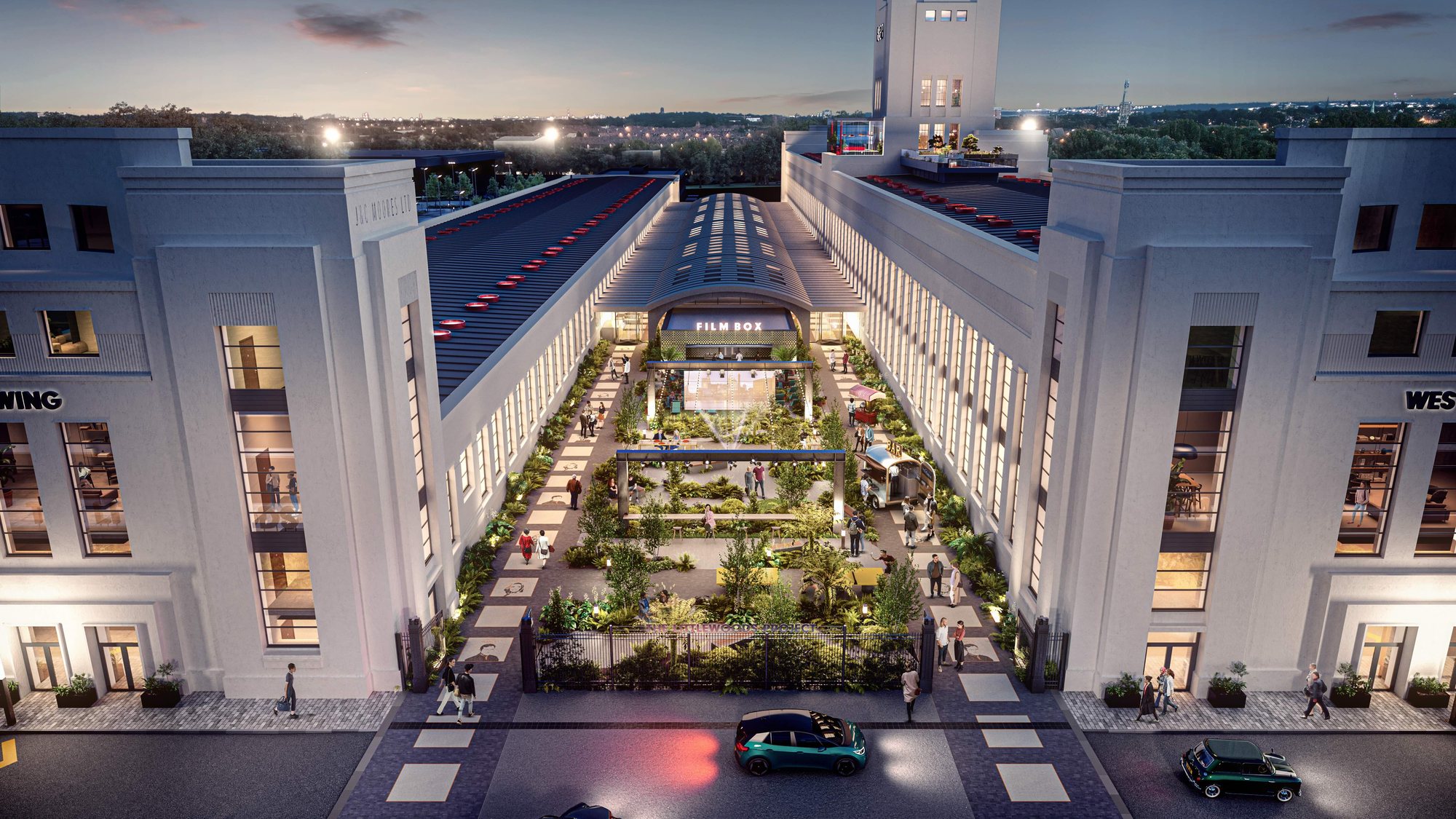
The UK government has pledged £20m towards turning Liverpool’s derelict Littlewoods Building into a film and television production campus, the chancellor, John Healey, announced in his Budget on Wednesday 28 October. The money comes from the Growth Mission Fund, a £240m pot for local job-creation and regeneration schemes between 2026–27 and 2029–30, and is subject to approval of a final business case. Since then the developer, Capital&Centric, has confirmed that Twickenham Studios, announced in 2018 as the scheme’s anchor tenant, is no longer involved.
Key facts
- £20m from the Growth Mission Fund for the Littlewoods site on Edge Lane, announced in the Budget on 28 October and subject to a final business case
- Liverpool City Region mayor Steve Rotheram had asked for £50m; the combined authority had committed up to £17m by February
- Capital&Centric says the Liverpool Creative Campus will offer more than 275,000 sq ft of studios, workspace and public space
- Twickenham Studios, which was to take up to 85,000 sq ft, has pulled out, Capital&Centric confirmed to the BBC
- A local authority spokesperson told Screen that construction should start within 12 months
The pledge keeps alive a project that has been discussed since 2017 and has yet to open a stage. For producers and studio operators in the north of England, the question is no longer whether there is political backing, but whether the funding stack is now complete and who will run the stages without Twickenham.
What the money covers
The scheme would convert the 1938 Art Deco building, where Littlewoods once processed football pools coupons, into what the developer calls the Liverpool Creative Campus: production studios, workshops, offices, education space and a public area, with uses that extend to music, gaming and AI. The plans include two studio stages of about 20,000 sq ft each, according to the Liverpool Echo, and a post-16 college, ScreenWorks Liverpool, for up to 800 students, according to Estates Gazette. The BBC gives the campus as 260,000 sq ft; Capital&Centric’s own figure is above 275,000 sq ft.
The building closed in 1994 and was badly damaged by fire in 2018. Work to clear and stabilise the site began in December 2023, and Liverpool City Council granted planning permission in October 2024, the BBC reports. Estates Gazette says the next phase is due to start on site next spring.

A funding gap the grant may not close
The delay has been about money. Capital&Centric had warned that the cost of delivering the project in the current climate was higher than the value of the finished development. The Architects’ Journal cites a Liverpool City investment guide that put the cost at £80m against an estimated value of £60m; Estates Gazette gives the gross development value as around £70m. Rotheram said in February that he was “desperate” to get the scheme moving but acknowledged a shortfall.
Capital&Centric’s John Moffat told BBC North West Tonight that the scheme “does need more than £20m” but that the grant unlocks further funding. The company’s co-founder Tim Heatley said the campus could eventually support around 4,000 jobs in the region’s creative sector and pointed to the 301 productions Liverpool hosted in 2023. The Architects’ Journal, citing the plans, gives a lower figure of around 630 permanent jobs and £56m a year for the local economy once the site is fully running.
Kris Brown, a Liberal Democrat councillor for Gateacre who says he raised concerns about the project’s financial risks in 2021, told the BBC that Liverpool could not afford “any more false dawns”. He called for a main contractor on site and “rigorous, transparent oversight” by the council.
Without its studio operator
Twickenham Studios, the London facility behind productions such as War Horse (2011) and The Iron Lady (2011), said as recently as 2024 that it was still committed, the BBC reports, although it dissolved a company called Twickenham Studios Liverpool Ltd in 2023. Neither the BBC nor Screen had a comment from Twickenham, and it is not known when or why it withdrew.
A Capital&Centric spokesperson told Screen that demand from occupiers had never been the problem and that the buildings could have been let three or four times over; the obstacle was giving tenants certainty about when the space would be ready. Screen lists The Batman Part II, Clayface and the BBC series This City Is Ours among recent productions shot in Liverpool. Lynn Saunders, head of the Liverpool Film Office, told the BBC that productions come to the city but find too little workshop and support space once they arrive. Other recent UK coverage: Channel 4’s move onto Disney+, the BFI’s works-in-progress showcase for buyers and the latest UK and Ireland box office.
Our reading
The £20m matches the gap in the investment guide’s numbers almost exactly, which is why the developer calls it the missing piece. It is not yet cash: it is a pledge subject to a business case, and the developer itself says more money is needed. Losing Twickenham matters less for the build than for the business plan. Without a named operator, Capital&Centric has to persuade lenders that visiting productions and creative tenants will fill the space. The next things to watch are the business case decision, the appointment of a main contractor and whether a studio operator is named before work starts next spring.
Sources
- Capital&Centric, £20m in the Budget for Littlewoods (28 October 2026)
- BBC News, Littlewoods film studios plan given £20m Budget boost (28 October 2026)
- BBC News, Littlewoods project backed despite studios pull-out (October 2026)
- Screen International, Littlewoods complex gets £20m government backing (30 October 2026)
- The Architects’ Journal, £20m boost for Liverpool Littlewoods plans (October 2026)
- Estates Gazette, Funding secured to unlock Liverpool’s creative campus (October 2026)
- Liverpool Echo, John Healey pledges £20m for Littlewoods (28 October 2026)