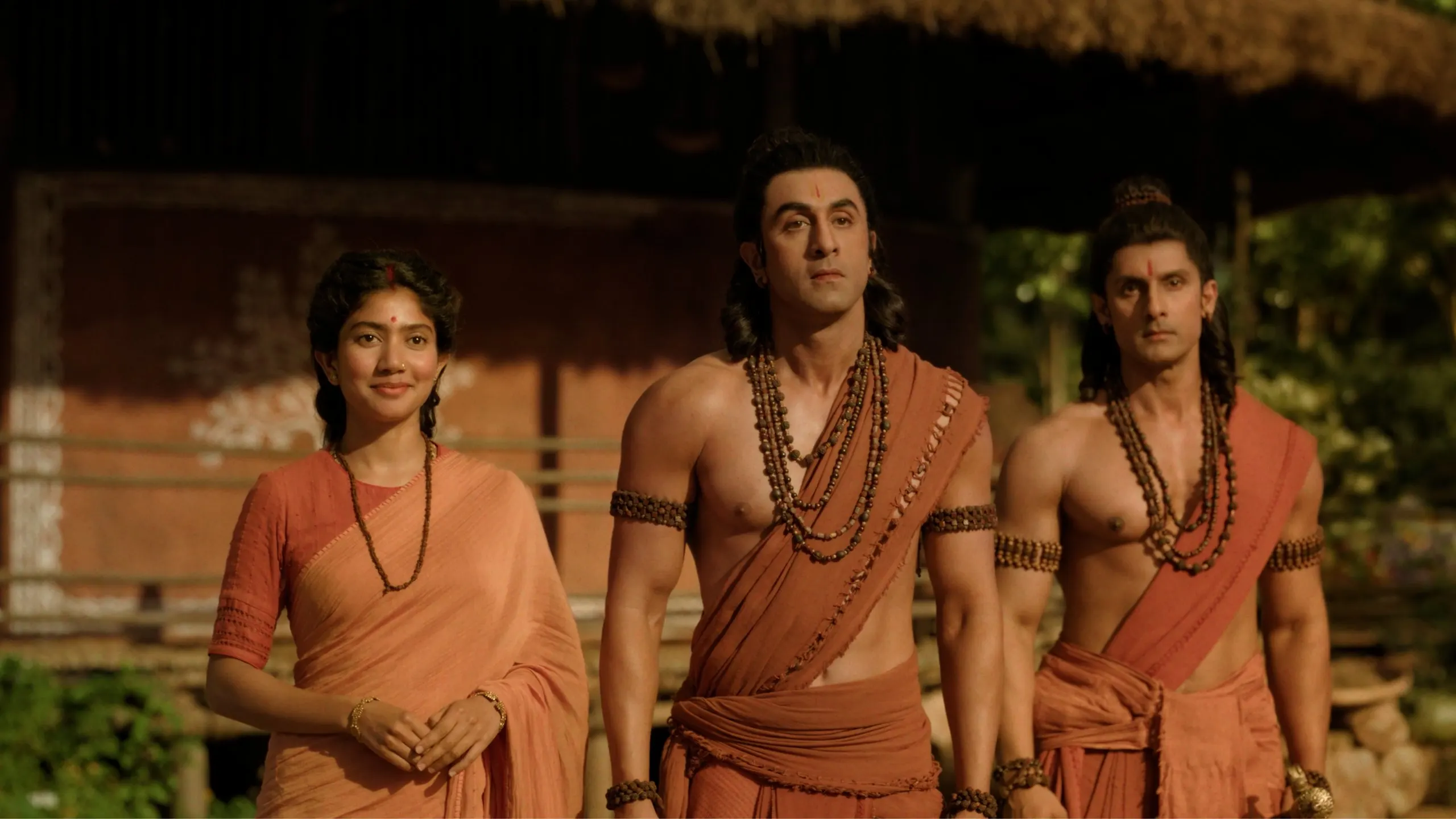
Ramayana: Part One, Nitesh Tiwari’s screen version of the Hindu epic, has grossed an estimated ₹221.05 crore ($23.5m) worldwide in its first two days, according to the box office tracker Sacnilk. The film, produced by Namit Malhotra’s Prime Focus Studios, opened on Thursday 5 November and passed ₹100 crore net in India on its first Friday, finishing the day at ₹112.90 crore ($12.0m) net and ₹134.80 crore ($14.4m) gross.
Key facts
- Ramayana: Part One (Prime Focus Studios, with DNEG and Yash’s Monster Mind Creations) opened worldwide on 5 November in Hindi, Tamil, Telugu, Kannada, Malayalam and English.
- Two-day worldwide gross: an estimated ₹221.05 crore ($23.5m), per Sacnilk, of which ₹86.25 crore ($9.2m) came from outside India.
- India net: ₹64.85 crore ($6.9m) on Thursday and ₹48.05 crore ($5.1m) on Friday, a 25.9% fall.
- Ranbir Kapoor plays Rama, Sai Pallavi Sita and Yash Ravana. The story concludes in a second film.
The India figures for both days are final, Sacnilk says; the figures for markets outside India are early estimates and may move as territories report. Prime Focus has not published a box office figure of its own. Hindustan Times, India Today and NDTV all circulate the same Sacnilk totals; no separate producer figure has appeared.
How the two days break down
Hindi carried the domestic run. On Friday the Hindi version took ₹35.50 crore net from 19,859 shows, Sacnilk reports, followed by Kannada (₹5.15 crore), Telugu (₹4.75 crore), Tamil (₹1.50 crore) and Malayalam (₹1.15 crore). Karnataka, Yash’s home market, was the strongest southern state at about ₹10 crore gross for the day, with Andhra Pradesh and Telangana at ₹7 crore.
Tamil Nadu and Kerala went the other way. Suriya’s Scene opened on Friday to ₹10.75 crore gross in Tamil Nadu, against ₹2.35 crore for Ramayana, and to ₹5.75 crore in Kerala, against ₹2.15 crore. A Hindi-led release that holds its screens in the north can still lose the south to a local star in one weekend.
NDTV puts ticket sales at roughly 1.8 million on Friday and above 4.3 million over two days. The three national multiplex chains, PVR, INOX and Cinépolis, accounted for ₹26.97 crore of Friday’s tracked gross including blocked seats, or 48.6% of the ₹55.46 crore tracked across India.
Against the comparisons
The obvious benchmark is Adipurush (2023), the previous big-screen Ramayana. Hindustan Times puts Adipurush’s opening day at ₹128 crore worldwide, fractionally above Ramayana’s ₹127.50 crore, and its two-day total at ₹215.78 crore, which the new film has now passed. Ramayana had the wider release: 23,316 shows in India against 16,120, by the paper’s count.
Against Kapoor’s own openings, the start is solid rather than record-breaking. Kapoor’s Animal (2023) also took two days to pass ₹100 crore net but stood at ₹130.07 crore at that point, against ₹112.90 crore here. Brahmastra (2022) and Sanju (2018) needed three. Yash’s KGF: Chapter 2 (2022) and this year’s Toxic each cleared ₹100 crore net on their opening day. None of these totals is adjusted for inflation or ticket prices, and Animal had the benefit of a Saturday second day.
The share from outside India is the more unusual number. At ₹86.25 crore, those markets supply about 39% of the two-day gross, a high proportion for a Hindi-led release, and one that fits the producers’ decision to open in English as well as five Indian languages.
What is not known, and what comes next
The budget is the largest open question. NDTV reports a combined cost of ₹4,000 crore ($426m) for the two films; Prime Focus has not confirmed a figure, and nothing public separates what the first part cost from the second. Without that, and without a producer total with a market split, any read on profitability is guesswork.
Diwali falls on Sunday 8 November, so Saturday and Sunday will show whether family audiences turn a front-loaded opening into a holiday run. Sacnilk reports Saturday advance sales well up on Friday’s. Conversions use the European Central Bank reference rate for Friday 6 November (₹93.92 to the dollar, cross-calculated from the euro).
For context on the market, see our report on India’s record July–September quarter and on Jailer 2’s run to the Tamil record, along with our Box Office section and India page.
Our reading
Ramayana was built to travel. Malhotra also runs DNEG, the visual-effects house behind Hollywood features such as Dune, and the film opened in English alongside the Indian languages. Two days in, markets outside India are carrying their share; at home the picture splits, with Hindi and Karnataka strong and Tamil Nadu and Kerala lost to a local release.
The figures that matter are still ahead. A two-part epic at a reported ₹4,000 crore needs a long run, not a fast milestone, and the Diwali weekend will say more than the opening did. Distributors outside India will watch their own second weekends before they price the second film.