Almost half of the film workers who answered the Film and TV Charity’s latest Looking Glass survey of mental health said they had been bullied, harassed or discriminated against at work in the past year, the same share as two years ago. Across UK film, television and cinema as a whole the rate fell again, to 37%, and most of the survey’s measures of mental health improved.
The report, Looking Glass 2026, was published on Tuesday 10 November and draws on 3,394 responses gathered between 11 May and 22 June. It is the fifth edition of a study the charity began in 2019, and its appendix tables break the results down by industry area. Film’s 48% is unchanged from 2024 and the highest of the six areas the charity reports; on high-budget features, those costing £30m or more, the figure is 53%.
Key facts
- Survey: 3,394 respondents across UK film, TV and cinema, 11 May to 22 June 2026 (4,376 in 2024)
- Poor or very poor mental health: 31%, down from 35% in 2024, against a UK workforce average of 16%
- Suicidal thoughts in the past 12 months: 23% of those who answered, down from 30%
- Bullying, harassment or discrimination: 37% overall (41% in 2024, 53% in 2021); 48% in film, unchanged
- Permanent staff in cinema, exhibition and festivals: poor mental health up from 23% to 36%
Better, from a low base
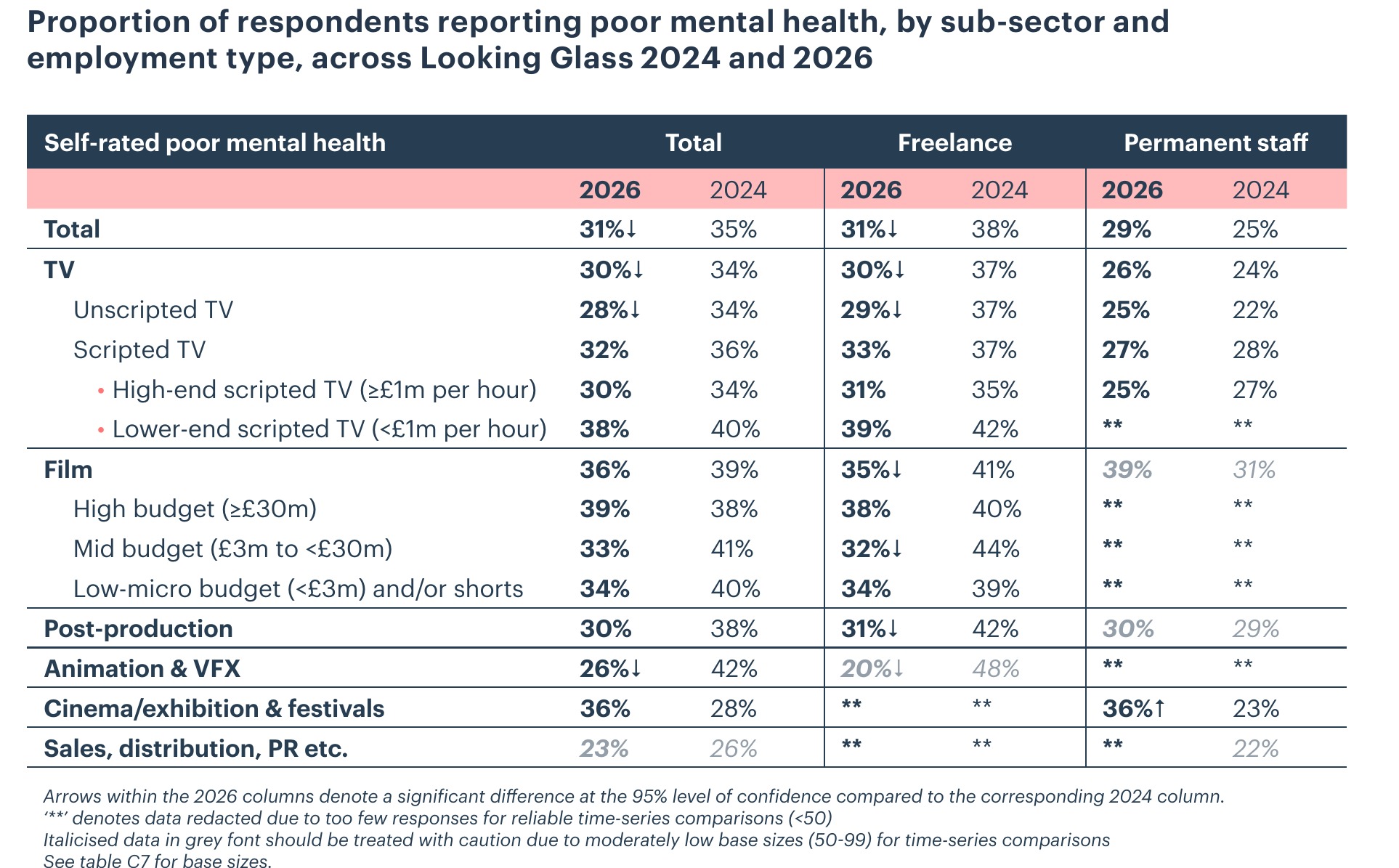
The charity’s verdict is that mental health in the industry remains “unacceptably poor”, but that there are “grounds to be cautiously encouraged”. Just under a third of respondents (31%) rated their mental health poor or very poor, nearly twice the 16% recorded for the UK workforce in the CIPD’s Good Work Index. That is better than 2024’s 35% but well above the 26% of the first survey in 2019. A quarter (25%) reported high levels of loneliness, down from 30%. Among those who chose to answer questions on the subject, 23% had had suicidal thoughts in the previous 12 months, down from 30% but more than three times the 7% average among adults in England.
More than half (56%) said working in the industry harmed their mental health, down from 63% and more than double the UK workforce average of 25%. Only 13% agreed that film and TV is a mentally healthy place to work. Over the previous year, 62% had considered leaving the industry because of their mental health, and 30% had taken firm steps to do so.
The gains were concentrated among freelancers, who supplied 2,532 of the 3,394 responses. Among them, poor mental health fell from 38% to 31% and suicidal thoughts from 32% to 23%. Among permanent staff, poor mental health edged up from 25% to 29%, a change the report does not treat as statistically significant. The charity notes that the freelancers who responded in 2026 look much like those of 2024, which in its view makes it unlikely that the improvement simply reflects the most vulnerable leaving the industry.
Film: shorter hours, the same behaviour
Film’s 574 respondents improved on most counts. Suicidal thoughts fell from 37% to 28%, the share saying work harmed their mental health from 64% to 55%, and the share who had worked 50 hours or more in the previous week from 25% to 18%. Poor mental health stood at 36%, against 39% in 2024, a difference the report does not count as significant.
Bullying, harassment and discrimination are the exception. Television’s rate fell from 42% to 37%; film’s stayed at 48%. Within film, low and micro-budget work held at 44%, and mid-budget productions (£3m to under £30m) came in at 43%, against 49% in 2024. High-budget film stands out on every pressure measure: 53% experienced the behaviours, 29% had worked 50 hours or more in the previous week, the highest of any sub-sector in the tables, and 63% said the job harmed their mental health.
Across the industry, the overall 37% is around two and a half times the UK workforce average, which the report puts at between 14% and 16%. Half of those affected (51%) did not report what happened, citing fear of losing future work, worry that reporting would make things worse and doubt that anything would be done. The share saying their workplace had a clear policy and process for reporting rose from 35% to 44%, and 51% now know where to get support, up from 45%. Only about a third, however, believe a report would be acted on whoever the perpetrator was.
The one group going backwards
The same tables single out one group whose mental health got significantly worse: permanent staff in cinema, exhibition and festivals, where the share reporting poor mental health rose from 23% to 36%. The sub-sector is a small part of the survey, with 151 respondents, 115 of them permanent staff, and it has the lowest rate of sustained worklessness in the industry, at 3%. The report does not explain the rise.
Work, and the lack of it
Work remains scarce. In 2026, 15% of respondents were out of work when surveyed and had worked fewer than three of the previous 12 months, the same as in 2024 and three times the 2022 level; their median time since a last industry job was about eight months. Only 18% felt secure in their job, up from 13% in 2024 but below the 28% of 2022. Long hours continued to recede: 14% had worked 50 hours or more in the previous week, against 18% in 2024 and 33% in 2022.
The burden is not shared evenly. Workers with a disability or long-term health condition, neurodivergent workers, carers, LGBTQ+ workers, Black and Global Majority workers and those from working-class backgrounds all fared markedly worse across several measures. Almost half (49%) of disabled respondents rated their mental health poor, against 25% of non-disabled respondents.
What the charity wants
Marcus Ryder, the charity’s chief executive, writes in the report’s foreword that a single percentage-point shift on a key measure can mean “around 2,000 to 2,500 more people experiencing the industry as a mentally healthy place to work”. He points to bullying, harassment and discrimination, “down by almost a third compared to five years ago”, as evidence of what “sustained, sector-wide action can achieve”, and asks commissioners, producers, broadcasters, streamers, studios, funders, unions and government to use the findings to set priorities and measure progress. The charity’s instrument for that is its Principles for Mentally Healthy Productions, drawn up with more than 45 industry organisations.
Our reading
The industry-wide figures describe slow repair; the sector tables complicate the story. The fall in bullying that the charity credits to years of collective pressure has reached television but not film, and the biggest productions, with the largest crews and the longest hours, report it most. That puts the onus on the producers, studios and financiers who set the terms of big-budget shoots, the people best placed to turn the charity’s production principles into practice.
Insecurity is the constant. One respondent in seven had barely worked for a year, and the strain is not confined to Britain: in the US, motion picture and sound recording employment is still 5.6% below a year ago. The 2,069 television workers in the sample face a market being redrawn, with Disney+ to carry Channel 4 from 2027 and Sky’s £1.6bn ITV deal under a public-interest notice. The rise among permanent cinema staff is the result the headline improvement most easily hides. The next Looking Glass survey will show whether productions that adopt the principles can move film’s 48%.
The Film and TV Charity’s free 24/7 Support Line for people working in film, TV and cinema is on 0800 054 0000.
Sources
- The Film and TV Charity, Looking Glass 2026: Mental health and wellbeing in UK film, TV, and cinema (report PDF, November 2026), incl. Appendix C tables C1–C8
- The Film and TV Charity, Looking Glass Report 2026 page, 10 November 2026
- Screen International (Broadcast), Looking Glass survey report, 10 November 2026