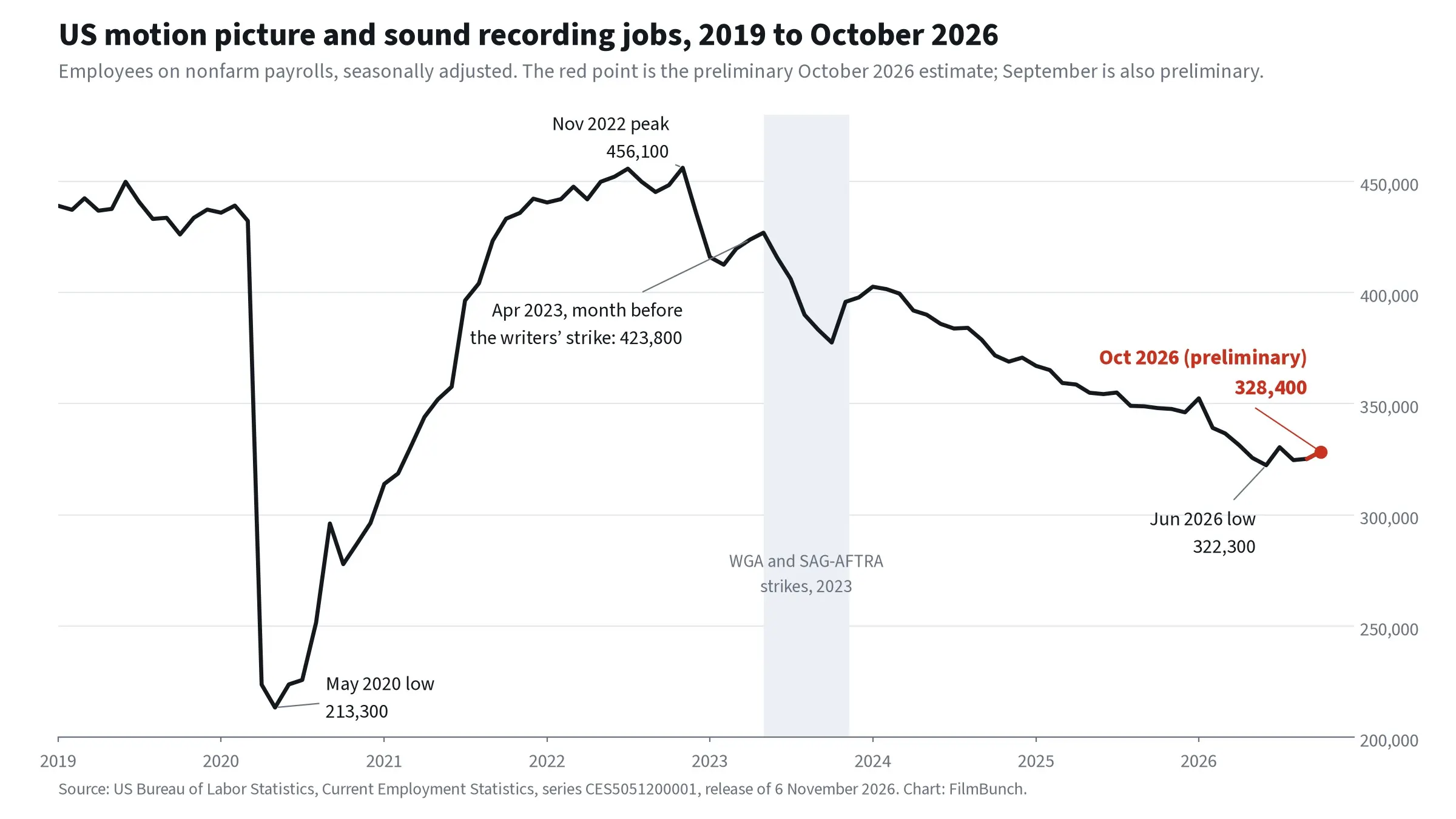
Employers in the US motion picture and sound recording industries added 3,200 jobs in October, taking seasonally adjusted payroll employment to 328,400, the US Bureau of Labor Statistics (BLS) reported in its Employment Situation release on Friday 6 November. The gain is small beside a long slide. The category, which the BLS uses for film and television production, post-production, distribution, cinemas and recorded music, is 19,600 jobs (5.6%) below October 2025 and 127,700 (28.0%) below its November 2022 peak of 456,100.
Key facts
- October 2026: 328,400 employees on payrolls in motion picture and sound recording industries (seasonally adjusted, preliminary), up 3,200 on September’s 325,200
- Year on year: down 19,600 (5.6%) from 348,000 in October 2025, while total US nonfarm payrolls rose 0.6%
- Earlier levels: 28.0% below the November 2022 peak, 22.5% below April 2023 (the month before the writers’ strike) and 25.2% below February 2020
- Neighbouring groups: publishing industries lost 4,100 jobs to 880,000; broadcasting and content providers added 200 to 327,600
- Whole economy: nonfarm payrolls up 165,000 in October, unemployment at 4.1%
For anyone budgeting a US shoot or hiring crew, the direction matters more than the month. The series has fallen in 26 of the 33 months since January 2024, even as the whole economy added 165,000 jobs in October against a 12-month average gain of 48,000.
What the BLS counted
The figures come from Table B-1 of the Employment Situation release, under the heading “Motion picture and sound recording industries”. That is NAICS subsector 512, which the BLS industry page and the Census Bureau’s classification define as film, video and television production and distribution, cinema exhibition, post-production services and sound recording. It is a wider net than production alone: cinema chains such as AMC Theatres, which reported a record third quarter, have their cinemas counted here.
The count covers employees on payroll records for the pay period that includes 12 October. Self-employed people with unincorporated businesses are excluded, and someone with two jobs is counted twice, according to the BLS technical note. Every figure here is seasonally adjusted; the unadjusted October level was 327,900, 5.1% below a year earlier.
October and September are both preliminary. The BLS revises each month in the next two releases and treats it as final only after the second, so September’s 325,200 may still move. The November report is due on 4 December.
Down since the 2023 strikes, with a small turn
Employment was 423,800 in April 2023. The Writers Guild of America went on strike on 2 May and SAG-AFTRA followed on 14 July. Employment fell to 377,500 in October 2023, recovered to 402,600 by January 2024, then fell again. It is now 74,200 jobs (18.4%) below that January level, while the information sector that contains the category lost 119,000 jobs (4.2%) in the year to October.
This year follows the same pattern in miniature. Employment stood at 346,100 in December 2025 and has lost 17,700 jobs (5.1%) since. It reached 322,300 in June, its lowest since February 2021. July added 8,100, August lost 5,800, September added 600 and October 3,200, leaving the level 6,100 above the June low.
Publishing and broadcasting
Publishing industries lost 4,100 jobs in October to 880,000, a sixth consecutive monthly fall, leaving the group 23,500 (2.6%) below October 2025. Broadcasting and content providers, which includes streaming distributors under the 2022 classification, added 200 jobs to 327,600, still 15,200 (4.4%) fewer than a year earlier.
What the figures do not show

Table B-1 gives no split inside the film category, so the release cannot say how much of the change is production, cinemas or music. The data are national, not Los Angeles. FilmLA counted 4,171 on-location shoot days in Greater Los Angeles in July to September, 4.8% fewer than a year earlier, a count of activity that says nothing about payroll jobs (our report on California’s tax credit plan has the detail).
Nor can the data be tied to employers. FilmBunch has reported on job cuts at Skydance and Netflix and the reported halving of Hello Sunshine’s staff, but the national series does not show where jobs were lost. The BLS industry page also lists a household-survey unemployment rate for people whose last job was in the category: 19.3% for October, against 10.7% for September. That survey covers about 60,000 households, so a small industry’s figure swings widely and we treat it as a warning sign only.
Our reading
October’s rise can reverse on revision. The firmer signal is that US employers in this category have shrunk since January 2024 while payrolls across the economy grew, and that the post-strike rebound to 402,600 did not hold.
The first test is whether July’s and October’s gains survive revision and extend in the November report. The second is the split between production and the rest of the category, which the BLS table does not give. Policy aimed at the gap, such as California’s proposal to lift its film and TV credit to at least $1bn a year, would show up in shoot-day counts like FilmLA’s before it reaches a payroll series that is revised for two months and benchmarked once a year.
Sources
- US Bureau of Labor Statistics, The Employment Situation: October 2026 (release USDL-26-1632, 6 November 2026)
- US Bureau of Labor Statistics, Employment Situation Table B-1: employees on nonfarm payrolls by industry sector and selected industry detail, October 2026
- US Bureau of Labor Statistics, Employment Situation technical note, October 2026
- US Bureau of Labor Statistics, Public Data API, Current Employment Statistics series CES5051200001, CES5051300001, CES5051600001, CES5000000001 and CES0000000001 (queried 6 November 2026)
- US Bureau of Labor Statistics, Motion Picture and Sound Recording Industries: NAICS 512 (industry page)
- US Census Bureau, North American Industry Classification System, subsector 512 (2022)
- FilmLA Research, Q3 2026 on-location filming report, 21 October 2026 (PDF)
- NBC News, Hollywood writers can return to work after union and studios reach agreement to end strike (27 September 2023)
- ABC News, SAG-AFTRA members vote to ratify 3-year contract with studios (December 2023)
- Deadline, U.S. Added 165,000 Jobs In October; Entertainment Employment Rises (6 November 2026)