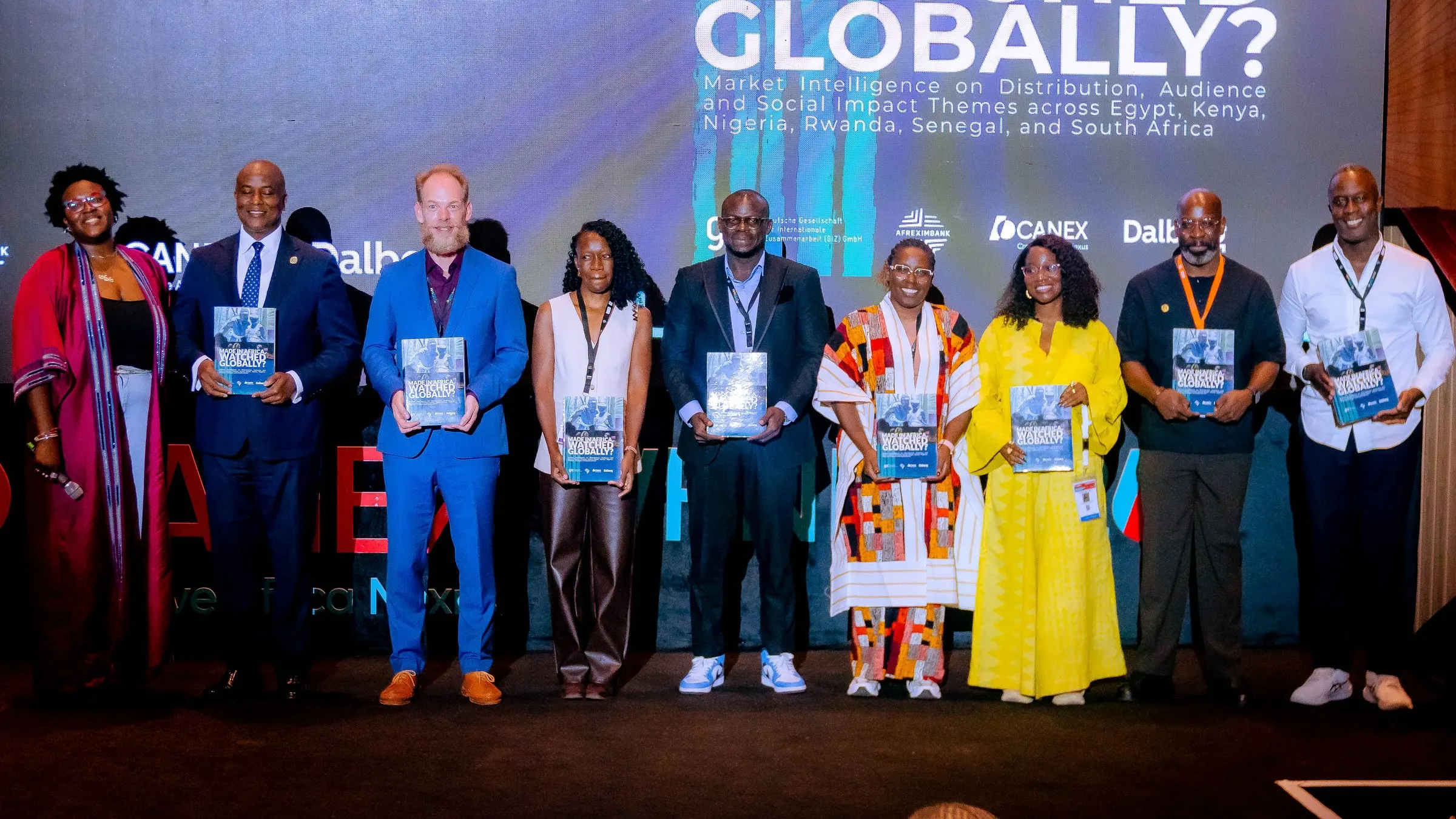
Pay-TV and streaming revenue in Africa will rise from an estimated $4.3bn in 2025 to $5.2bn by 2030, according to Made in Africa, Watched Globally?, a study by the consultancy Dalberg for Germany’s development agency GIZ and the Afreximbank creative programme CANEX. The study covers six markets, Egypt, Kenya, Nigeria, Rwanda, Senegal and South Africa. It was presented at CANEX WKND in Lagos on 6 November, and Afreximbank released its findings on Wednesday 11 November.
The headline total is the least of it. Underneath sits rare country-level data on screens, ticket prices and audiences, and a blunt conclusion, in Dalberg’s words: “Africa does not have a content problem. It has a route-to-market problem.” Screens are scarce, mobile data is expensive, and Showmax, the main outlet for MultiChoice’s local productions across the continent, closed in April.
Key facts
- Market: pay-TV and streaming revenue projected at $5.2bn by 2030, up from $4.3bn in 2025
- Fastest growth: South Africa at 6.8% a year to 2030; slowest Rwanda at 4.9%
- Screens: about one cinema screen per 787,000 people in Africa, against one per 8,700 in the US
- Nigeria: average ticket up from ₦1,512 in 2021 to ₦5,596 ($3.90) in 2025, while admissions fell from 3.3 million to 2.8 million
- Method: 91 industry interviews, a survey of 1,630 viewers and five case studies
Country by country
The scope of the $5.2bn figure is loosely drawn. Dalberg’s deck and the opening line of Afreximbank’s release call it Africa’s market; the release’s summary attaches it to the six countries studied. The country breakdown is clearer. It sits in the 64-page summary deck Dalberg published with the release, not in the release itself, and it ranks South Africa as the fastest-growing pay-TV and streaming market to 2030 at 6.8% a year, ahead of Nigeria (5.9%), Kenya (5.5%), Egypt (5.3%), Senegal (5.1%) and Rwanda (4.9%).
Egypt sells far more cinema tickets than any of the other five. The deck counts 140 cinemas with 437 screens, 14.3 million admissions and box office of about $37m, at an average ticket of $3.50. Egyptian films take more than 60% of that, led by Siko Siko at $3.7m. The study also credits Egyptian films with $53m at the Saudi box office in 2024, which it calls double their takings at home. Paid streaming is concentrated in two Arabic-language services: Shahid VIP, with 2.15 million subscribers, and Watch iT, with 1.25 million, hold about 88% of paid subscriptions.
Nigeria’s box office has tripled on price alone. Takings rose from ₦5bn in 2021 to ₦15.6bn ($10.8m) in 2025 as the average ticket climbed 270%, while admissions fell from 3.3 million to 2.8 million. The country makes more than 1,000 films a year, second only to India by Dalberg’s count, yet 93% of the titles classified by the National Film and Video Censors Board never reach a cinema. That is the pattern behind the records Nigerian cinemas have been setting this year.
South Africa has the densest screen network, 450 to 500 screens or about seven per million people, but the number of major cinema sites fell by a third between 2015 and 2025. Its 2024 box office was R549.3m ($29.1m), with admissions down 34.5% to 5.4 million. Elsewhere the map thins out fast. Kenya has 45 screens, more than three-quarters of them in Nairobi. About 90% of Egypt’s screens are in Cairo and Alexandria, and 83% of Senegal’s 18 are in Dakar. Rwanda has had a single commercial screen since the Canal Olympia Rebero cinema closed in late 2025.
What viewers spend
The survey asked viewers what they pay. South African respondents reported the highest median spending on every paid channel, $17.92 a month on streaming and $12.10 per cinema visit. Egyptians reported the lowest, $3.15 a month and $3.25 a visit. Dalberg stresses that the survey reflects the people sampled and is not nationally representative.
YouTube reaches more viewers than any paid service in all six countries: 87% of Kenyan respondents who stream films use it, and 98% of Senegalese. Senegal’s Marodi TV has built 8.67 million subscribers and 4.6 billion views on a free, ad-funded model. Reach rarely becomes steady income, the study warns, and the bar is rising. From 1 February 2027, new YouTube channels will need 1,000 subscribers and either 8,000 watch hours in a year or 20 million Shorts views in 90 days before they can share in advertising revenue.
The gap left by Showmax
Dalberg’s name for the problem is the “missing middle”: platforms able to pay licence fees and commission mid-budget local films and series. MultiChoice, Showmax’s parent, produced about 6,500 hours of local content a year in 22 languages, and Showmax was its main route across the continent until it closed. Amazon’s Prime Video paused its African originals in Nigeria and South Africa in 2023 and in Kenya in 2024, according to the deck.
The recommendations are written for funders. Development finance institutions should back African-owned platforms and aggregators that already have audiences; national and regional funds should pay for marketing, subtitling and dubbing; and grants and cheap loans should go to distribution companies rather than to individual productions. The study also wants regional licensing deals under the African Continental Free Trade Area.
“The next priority is to ensure that this growing demand translates into sustainable businesses and greater economic returns for African creatives,” said Osahon Akpata, chief executive of CANEX Creations, a subsidiary of Afreximbank’s equity investment arm. Victor Chudal-Linden, project manager at GIZ, said the value of the evidence “lies in how industry players, policymakers and partners use it together”.
Private money is moving the same way. EbonyLife and Logical African Partners this week launched a $50m Afro Film Fund for African features, and the Cairo International Film Festival runs until 20 November.
Our reading
A projected $900m of growth over five years, spread across six countries, will not change much for producers on its own. The country tables matter more, because they show two different markets that need different money. Egypt sells five times as many tickets as Nigeria at a lower price, and by the study’s count its films earn more in Saudi Arabia than at home: the constraint there is price and reach outside Cairo and Alexandria. Nigeria’s record takings rest on a shrinking audience paying almost four times as much as in 2021, which leaves most of its output with nowhere to play.
That is the case for the study’s central ask, finance for distribution rather than production, and it is aimed squarely at development lenders and funds. The test is whether any of them puts money behind an African-owned platform before the Showmax gap is filled by YouTube alone.
Sources
- Afreximbank, New six-country study finds strong demand for African stories, but distribution gaps continue to limit audience reach and revenue (Lagos, 11 November 2026)
- Dalberg, Made in Africa, Watched Globally? report summary deck (PDF, November 2026; country tables on screens, box office, admissions, subscribers, growth rates and household spend)
- Dalberg, Made in Africa, Watched Globally? report annexure and data set (November 2026)
- CANEX WKND 2026, session listing for the study's presentation (6 November 2026)
- BroadcastPro Middle East, African film and streaming market set to reach $5.2bn by 2030: Dalberg (12 November 2026)