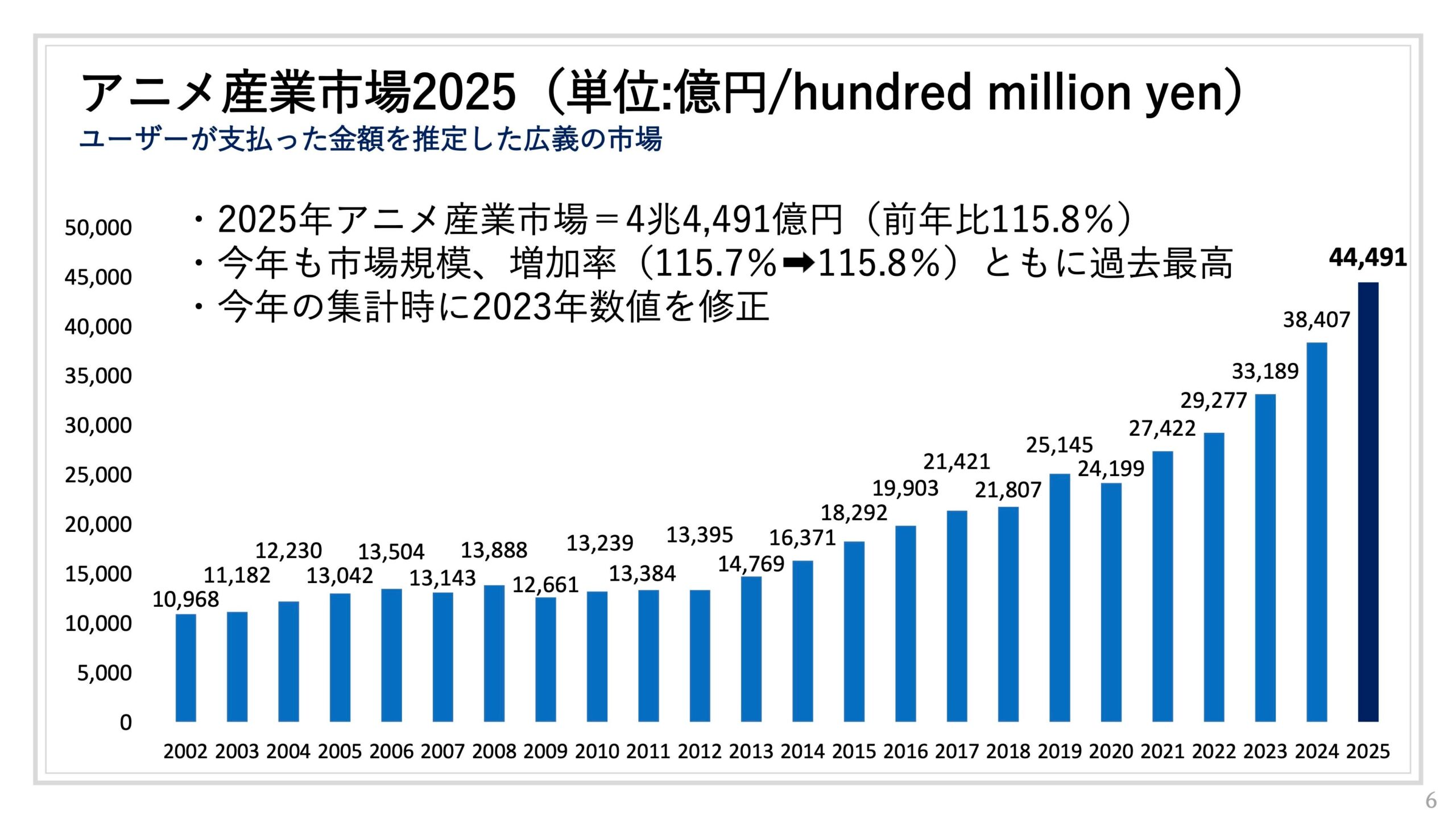
The Association of Japanese Animations (AJA) says Japan’s anime market reached a record ¥4.4491tn ($28.4bn) in 2025, up 15.8% on 2024. The trade body gave the preliminary figure at TIFFCOM, the content market that runs alongside the Tokyo International Film Festival, on Friday 30 October, ahead of its full Anime Industry Report 2026 in early December. Dollar figures here use the ECB reference rates for 31 December 2025.
Key facts
- Anime industry market (what consumers paid, all media): ¥4.4491tn ($28.4bn) in 2025, up 15.8%
- Overseas share: ¥2.5426tn ($16.2bn), up 17.2%, or 57.1% of the total
- Domestic share: ¥1.9065tn ($12.2bn), up 14.1%
- Studio revenue (the narrower industry measure): ¥505.5bn ($3.2bn), up 8.4%
- Full report due in early December, at a planned price of ¥22,000 including tax
Two measures, both at records
AJA measures the business in two ways. The broad measure estimates everything users spent on anime, from TV and cinema tickets to streaming, merchandise, music and live events. That figure rose from ¥3.8407tn in 2024 to ¥4.4491tn, and AJA says both the total and the growth rate are the highest it has recorded.
The narrower measure estimates the revenue of the animation studios themselves. It grew 8.4% to ¥505.5bn, also a record, after ¥466.2bn in 2024. Studios still earn most of that money at home: 72.1% came from Japan in 2025, against 74.5% a year earlier. The association notes that the domestic total includes fees for production work, but that more studios now take rights income from Japanese and foreign exploitation.
Abroad now outweighs home
The overseas portion of the broad market grew faster than the domestic one again. Spending outside Japan was ¥2.5426tn, up from ¥2.1702tn in 2024, which puts foreign markets at 57.1% of the total, up from 56.5% in 2024. In its release AJA says Japanese anime placing near the top of overseas cinema charts and global streaming rankings is no longer unusual, and that the breakthrough abroad “has been achieved”.
Respondents to the association’s industry survey pointed to localisation for language, culture and law, and to anti-piracy work, as the conditions for growing in the markets where they expect the next gains.
AJA also restated the government’s policy goal for content as a core industry: ¥20tn in overseas sales for games, anime, manga, live-action film and drama, and music by 2033, with anime expected to contribute ¥6tn. Prime minister Sanae Takaichi restated the ¥20tn target at the Tokyo festival this week. By our calculation, anime’s 2025 overseas sales are about 42% of its ¥6tn share of that goal.
Where the money is moving
The figures came in a TIFFCOM week busy with anime rights deals. Toei Animation, TBS and TV Tokyo have put money into AniBiz, a platform for licensing anime to merchandise and media partners, and TIFFCOM and the Marché du Film confirmed that the Japan IP Market returns to Cannes in May 2027 to sell Japanese properties to international buyers. More of our anime coverage and reports from Japan are on their own pages.
The Anime Industry Report 2026 breaks the market down by TV, theatrical, video, streaming, merchandising, music and live events, with a section on overseas trends and a survey of where Japan’s studios are based.
Our reading
For buyers, the split matters more than the total. Spending abroad has been larger than spending at home since 2023 and the gap widened again in 2025, yet studios still earn almost three quarters of their revenue in Japan. Most of the money made overseas goes to rights holders, distributors and platforms rather than to the companies that make the shows. That is why studios taking equity in their productions, and investment in licensing tools such as AniBiz, matter more than another record total.
The full report in December will show which media drove 2025. If cinema releases and streaming account for most of the overseas growth, Japanese studios will have a stronger argument for keeping more of their international rights in co-production talks at markets such as TIFFCOM and Cannes.